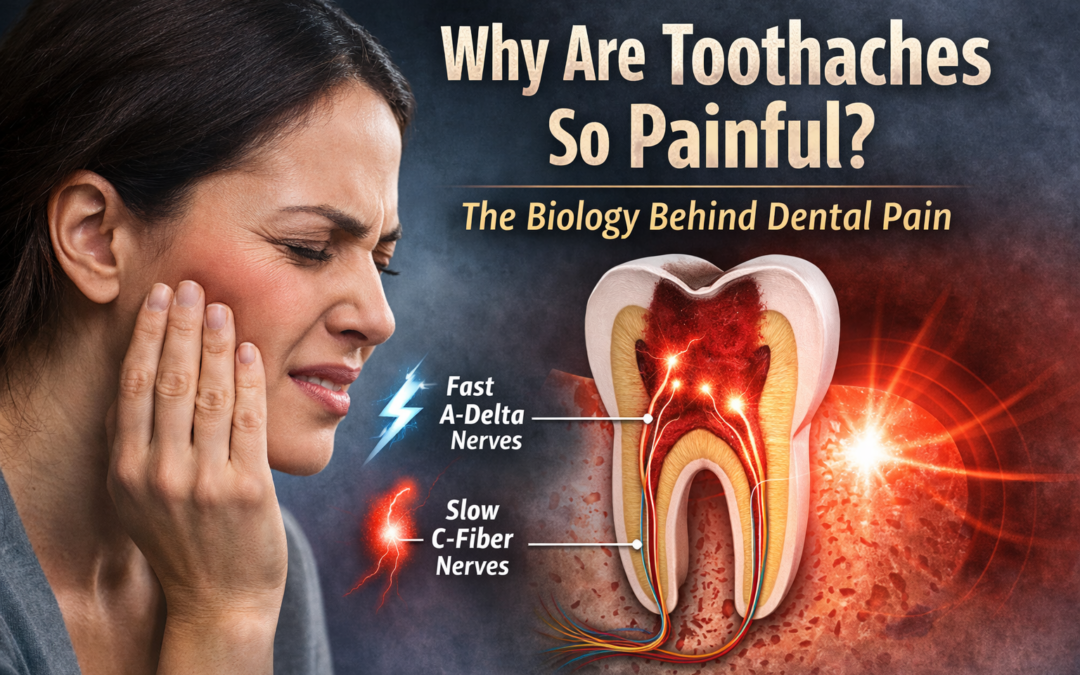
Why Are Toothaches So Painful? Understanding the Paradox
In earlier stages of decay, a cavity may not reach the pulp — the living tissue at the center of the tooth. At this point, there may be no symptoms. But once inflammation develops inside the pulp, the situation changes dramatically.
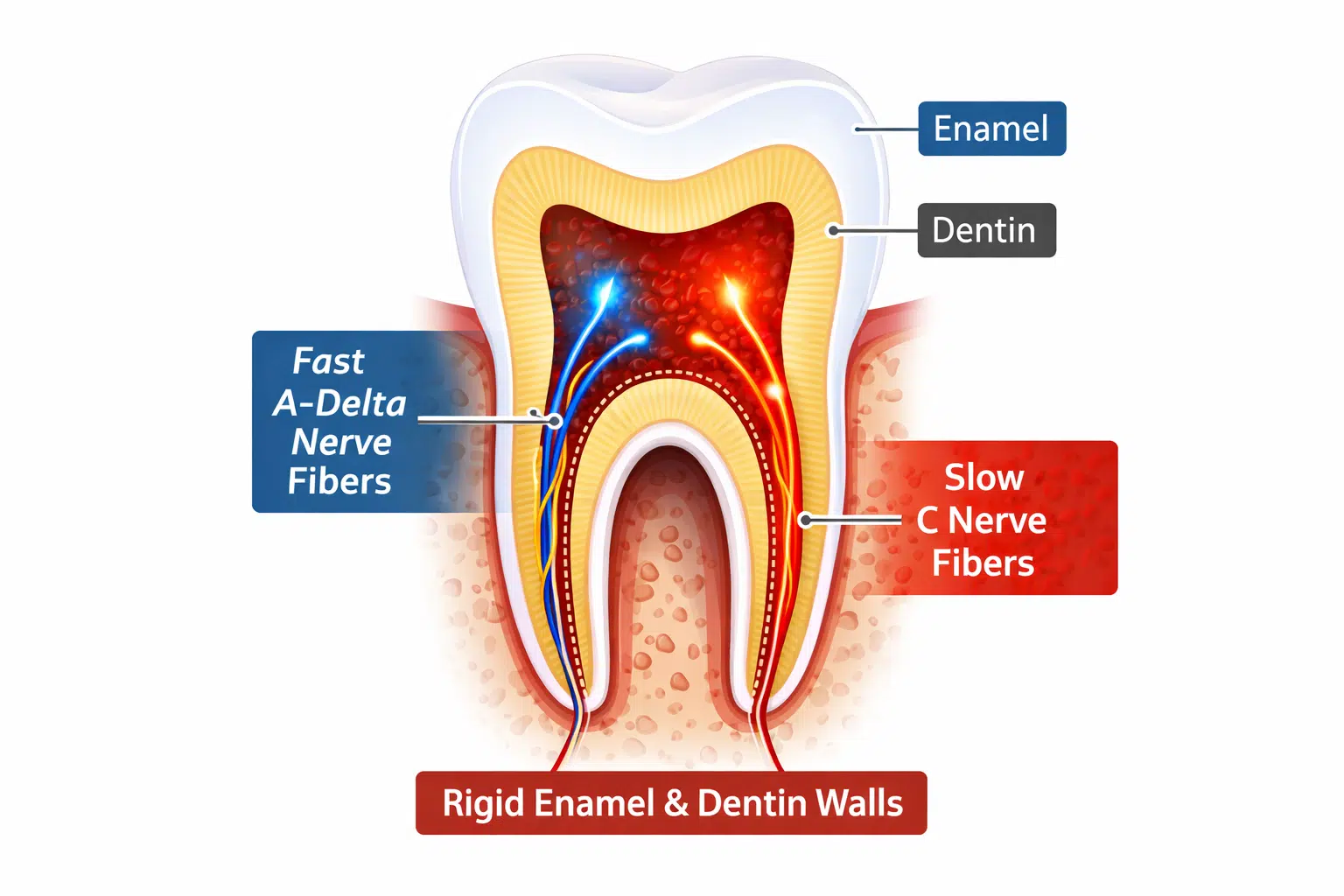
Unlike skin or muscle, the pulp is enclosed within rigid walls of dentin and enamel. It cannot expand outward when inflamed. This creates pressure inside a confined space — a critical factor in the intensity of dental pain.
Watch the Full Video Explanation
If you prefer a visual walkthrough, I explain the biology of why toothaches are so painful in this short video:
You can also watch the video directly on YouTube here:
Why Do Toothaches Hurt So Much?
The Biology Behind Dental Pain
The pulp contains specialized nerve fibers that function primarily as warning systems. Unlike your fingertips — which can distinguish texture, temperature, vibration, and pressure — your tooth is designed mainly to detect threat.
A-Delta Fibers: The Sharp Warning Signal
A-delta fibers are fast-conducting, myelinated nerves located near the outer portion of the pulp. Myelin is like insulation around an electrical wire — it helps signals travel quickly and more precisely. These fibers are responsible for sharp, quick sensations often triggered by cold air or cold liquids. This type of pain is usually brief and well localized.
In early irritation or reversible pulp inflammation, A-delta fibers tend to dominate. The pain may be sharp but short-lived.
C Fibers: The Deep, Throbbing Toothache
Deeper inside the pulp are C fibers — slower, unmyelinated nerves that respond strongly to inflammation. Because they lack that “insulation,” their signals travel more slowly and tend to feel duller, deeper, and harder to pinpoint. When pulp tissue becomes inflamed, blood flow increases and inflammatory mediators such as prostaglandins and bradykinin sensitize these fibers.
Because the pulp cannot swell outward, internal pressure rises. That pressure compresses nerve tissue and activates C fibers, producing the dull, throbbing, and sometimes excruciating pain associated with irreversible pulpitis.
This shift from A-delta to C fiber dominance helps explain why mild sensitivity can suddenly become overwhelming.
Why Teeth Don’t “Differentiate” Like Skin
Your fingertip can tell the difference between smooth and rough, warm and cool, oily or dry. It contains multiple types of sensory receptors.
The dental pulp is different. It contains primarily nociceptors — pain receptors. Whether the stimulus is cold, heat, air, or pressure, the pulp interprets disturbance as potential threat. In other words, your skin is designed to explore the world — your tooth is designed to warn you.
Much of this sensation is explained by the hydrodynamic theory: temperature or pressure changes cause fluid movement within dentinal tubules, stimulating nerve endings. The tooth does not “analyze” the sensation — it signals danger.
The Role of Inflammation and Pressure
Inflammation is the body’s protective response to injury or infection. In most tissues, swelling can expand into surrounding space. Inside a tooth, there is no room to expand.
As pressure builds, nerve fibers are compressed. Combined with chemical sensitization, this can create intense pain. Research in dental pain physiology continues to explore these mechanisms, including work summarized by institutions such as the National Institute of Dental and Craniofacial Research.
Inflammation-driven pain pathways are not unique to dentistry — they reflect broader principles of how the nervous system responds to tissue injury throughout the body.
Why Are Toothaches So Painful Compared to Other Types of Pain?
Many people wonder why are toothaches so painful compared to other injuries in the body. A sprained ankle swells outward. A cut on your finger bleeds and relieves pressure. But inside a tooth, inflammation has nowhere to go.
The pulp is sealed within rigid enamel and dentin. As blood flow increases and inflammatory chemicals accumulate, pressure builds in a confined chamber. That pressure compresses sensitive nerve fibers, especially C fibers, which are responsible for deep, throbbing pain.
It is this combination — nerve sensitization, inflammation, and confinement within a hard structure — that makes dental pain uniquely intense.
Frequently Asked Questions About Dental Pain
Why are toothaches so painful at night?
Many people notice that tooth pain worsens at night. When lying down, increased blood flow to the head can slightly raise pressure within an inflamed pulp chamber. Because the tooth is a rigid structure, even small increases in pressure can intensify nerve activation and make symptoms feel stronger.
Why are toothaches so painful compared to other injuries?
Unlike skin or muscle, the pulp inside a tooth cannot expand when inflamed. That confined space, combined with sensitive nerve fibers and inflammatory chemicals, is a major reason why are toothaches so painful when the pulp becomes irritated.
So Why Are Toothaches So Painful?
When we step back, three biological forces come together to create the intensity of a toothache.
First, the pulp is trapped inside a rigid chamber of enamel and dentin, so inflammation creates pressure with nowhere to escape.
Second, the tooth contains specialized nerve fibers — particularly A-delta and C fibers — that are designed primarily to detect threat, not subtle sensation.
And third, inflammation releases chemical mediators that sensitize those nerve fibers, amplifying the pain signal.
It is the combination of confinement, nerve specialization, and chemical sensitization that explains why toothaches can become so intense.
What This Means for Prevention
Understanding why toothaches are so painful helps clarify another important truth: pain often signals advanced inflammation. By the time severe pain develops, the pulp may already be significantly compromised.
This is why regular examinations and early detection matter. Dental disease can remain silent in its early stages — as discussed in an earlier article on asymptomatic cavities — but once the pulp becomes inflamed, the experience can change dramatically.
The mouth does not always warn us early. But when it does, it speaks clearly.
If you’re interested in learning more about the connection between oral health and overall wellness, explore additional articles at ToothWiz.com.