Keratin enamel remineralization is an emerging concept that may one day help rebuild early enamel damage using the same protein found in your hair. New research suggests this possibility is much closer than most people realize.
Keratin Enamel Remineralization: A New Direction in Tooth Repair
Tooth enamel is incredibly strong—harder than bone—but it has one major limitation: once its deeper structure breaks down, the body cannot rebuild it. Early enamel erosion often appears as faint, chalky “white spot lesions.” These spots represent weakened enamel where minerals have dissolved away. If this mineral loss continues unchecked, it eventually becomes a cavity.
Traditionally, once enamel reaches a certain level of damage, the only reliable treatment has been to remove the weakened area with a dental drill and restore it with a filling. But modern dental research is shifting toward a different philosophy: repairing enamel at its earliest stages before a cavity forms. This is where keratin enamel remineralization becomes especially interesting.
Biomimetic = bio (life) + mimetic (to imitate).
In dentistry, biomimetic methods try to copy the way the body naturally grows or repairs tissues. Instead of patching enamel, the goal is to help the tooth rebuild structures that behave more like the real thing.
Why Keratin Matters
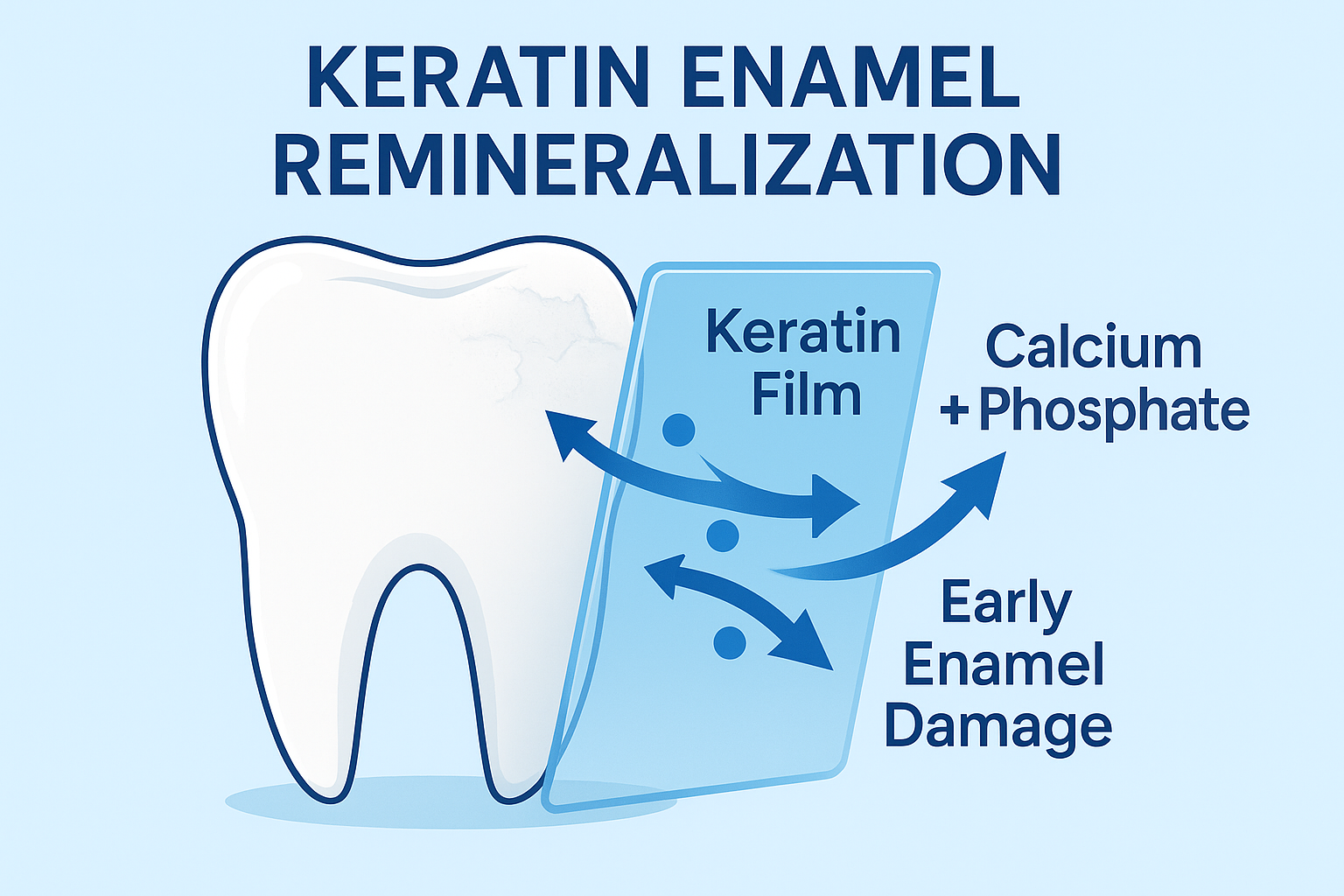
Keratin is the fibrous protein that makes up hair, nails, and the outer layer of skin. When researchers process keratin into thin, water-based films, it forms a delicate network capable of guiding mineral growth. This “support structure,” or scaffold, can help minerals organize in a more natural way.
A recent study published in Advanced Healthcare Materials explored how keratin films behave when exposed to calcium and phosphate ions—the same minerals that create hydroxyapatite, the crystal mineral that gives enamel its hardness. Under microscope analysis, the keratin films provided an orderly framework that encouraged minerals to settle into patterns that closely resemble natural enamel.
Breaking Down the Science in Simple Terms
Healthy enamel is built from tightly packed hydroxyapatite crystals aligned in a very specific pattern. When enamel weakens, these crystals break apart, leaving the surface porous and vulnerable.
The keratin films used in the study acted like a blueprint. Instead of letting minerals clump randomly, the keratin structure guided them to grow in straight, organized layers—much like the original enamel pattern.
Compared to untreated enamel lesions, keratin-supported areas showed:
- stronger structure with greater resistance to wear
- smoother, shinier surfaces
- reduced visibility of white spots
- improved mineral density and uniformity
These improvements suggest that keratin enamel remineralization may enhance natural repair far more effectively than saliva alone.
Study reference: See PubMed summary.
Why This Discovery Matters for Patients
If keratin-based treatments eventually reach dental offices, they may offer a way to repair early enamel damage without drilling. Instead of removing weakened tooth material, dentists might reinforce and rebuild it. This shift could benefit individuals with:
- white spot lesions from early decay
- acid erosion caused by diet, dry mouth, or reflux
- demineralization during orthodontic treatment
- tooth sensitivity from enamel thinning
Keratin enamel remineralization won’t replace fillings, crowns, or traditional treatments—but it may reduce how often patients need them.

How Keratin Compares to Other Remineralizers
Keratin isn’t the only approach to restoring weakened enamel. Other modern strategies include:
- Nano-hydroxyapatite toothpaste – provides particles similar to natural enamel
- CPP-ACP (casein phosphopeptide–amorphous calcium phosphate) – delivers calcium and phosphate in a stabilized form
- Fluoride therapy – hardens enamel and slows mineral loss
- Saliva enhancement – crucial because saliva naturally protects and repairs enamel
The difference is that keratin helps minerals form in an organized pattern, not just accumulate. That means the regenerated enamel may behave more like the original enamel, increasing its durability.
What Dentists Are Watching Next
Researchers are continuing to study how keratin can be refined, strengthened, and incorporated into clinically usable treatments. Key areas of focus include:
- how to apply keratin films directly to tooth surfaces
- whether keratin can be combined with other minerals for faster results
- how durable keratin-based repairs are under chewing forces
- whether consumers could one day use over-the-counter keratin products
While these questions remain, the direction is clear: dentistry is moving toward regenerative repair rather than mechanical removal.
How You Can Strengthen Enamel Right Now
Even though keratin enamel remineralization is still in development, you can support your enamel today by:
- brushing twice daily with nano-hydroxyapatite toothpaste
- limiting acidic drinks like soda, kombucha, and citrus water
- avoiding frequent snacking, which constantly exposes teeth to acid
- drinking water throughout the day, especially if dry mouth is an issue
- seeing your dentist regularly to catch early enamel changes
If you want to explore additional ways to support enamel and whole-body wellness through nutrition, visit ToothWiz Vitamins. For more unique dental science, see Weird Dental Facts.
Looking Ahead
The idea that a protein known for strengthening hair might help repair enamel is surprising—but it reflects how quickly dental science is evolving. As biomimetic materials continue to advance, the future may involve fewer drills, fewer fillings, and more natural tooth preservation.
For now, the key message is this: early enamel damage doesn’t have to be permanent. With breakthroughs like keratin enamel remineralization on the horizon, we are closer than ever to helping teeth heal themselves.