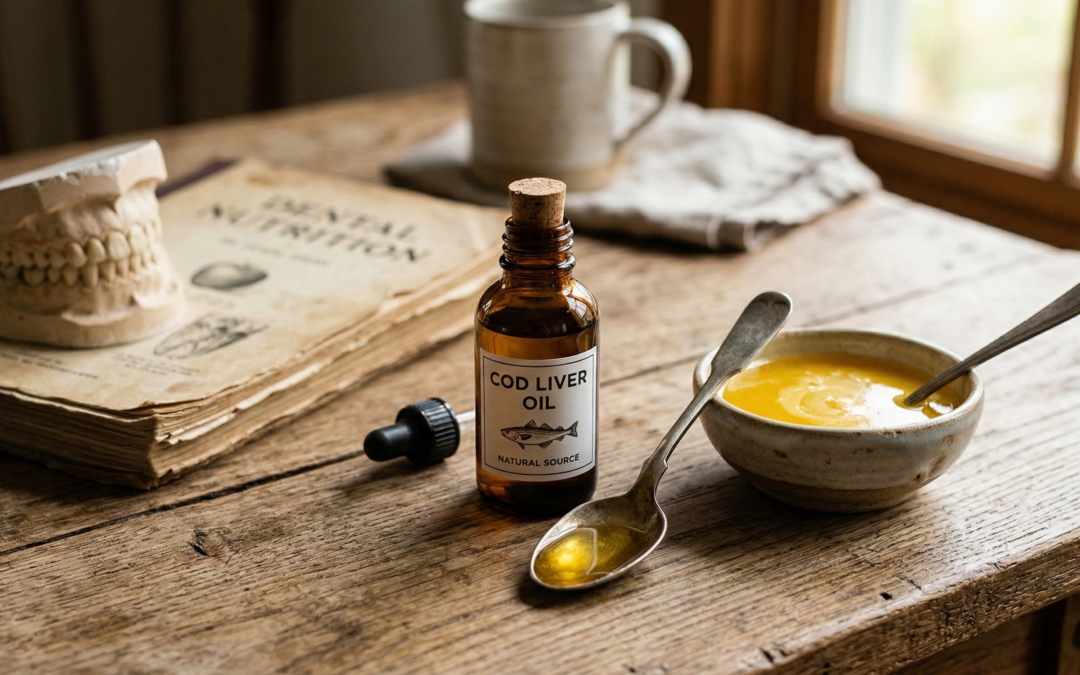
Cod liver oil for teeth may sound old-fashioned, but the idea behind it is surprisingly compelling. Long before modern wellness trends and expensive dental products, dentist and researcher Dr. Weston A. Price observed that traditional diets rich in fat-soluble nutrients were associated with stronger teeth, broader dental arches, and lower rates of decay. Among the foods he valued most were cod liver oil and high-vitamin butter oil.
That connection is one reason I have continued to use two Green Pasture products daily: their Fermented Cod Liver Oil and their Concentrated Butter Oil. These are not miracle products, and they are not a substitute for brushing, flossing, or professional dental care. However, they do fit into a broader philosophy that many people overlook: healthy
teeth are not just cleaned from the outside — they are also supported from within.
For anyone interested in the nutrition side of oral health, these two traditional fats are worth understanding, especially if you are curious about whether cod liver oil for teeth makes sense in a broader wellness strategy.
Why Weston A. Price Still Matters in Dentistry
Dr. Weston A. Price was a dentist who became deeply interested in why some populations had excellent teeth and facial development while others developed widespread tooth decay, crowded arches, and narrowing of the jaws. In his travels, he studied traditional cultures eating nutrient-dense ancestral diets and compared them with people consuming more modern refined foods.
Again and again, he found a pattern: groups eating traditional foods had better oral health, fewer cavities, and more robust facial development. When processed flour, sugar, and nutrient-poor industrial foods entered the picture, dental problems rose quickly.
Price believed that deficiencies in fat-soluble vitamins played a major role in this decline. In particular, he emphasized the importance of the nutrients found in cod liver oil and in what he described as “high-vitamin” butter oil from cows grazing on rapidly growing green grass. His observations were later published in his landmark book, Nutrition and Physical Degeneration.
If you enjoy exploring the intersection of nutrition and oral health, you may also want to read our related article on the future of dental health and tooth regeneration.
Fermented Cod Liver Oil for Teeth and Whole-Body Nutrition
Green Pasture describes its fermented cod liver oil as containing a natural balance of omega-3 fatty acids along with vitamins A and D. Those nutrients are central to why many people look at cod liver oil for teeth rather than simply as another general supplement.
Vitamin A helps support healthy tissues, including the soft tissues of the mouth. Vitamin D plays an important role in calcium metabolism and mineralization, both of which matter when we are talking about strong teeth and bone. Omega-3 fatty acids are also well known for their role in helping the body regulate inflammation, which may be relevant for gum health and overall wellness.
What makes this product distinctive is the way Green Pasture presents it: a traditionally extracted cod liver oil made from wild-caught Alaska cod from the Aleutian Island region. The company notes that the fishery is MSC certified and traceable from ocean to bottle. They also emphasize that natural vitamin A and D levels vary from batch to batch depending on the source, season, age, and diet of the fish.
Many people today are rediscovering cod liver oil for teeth because it offers a food-based source of nutrients long associated with bone and dental health. That does not mean it reverses cavities on its own. It does mean that it may support the nutritional foundation your teeth depend on.
What Exactly Is Fermented Cod Liver Oil?
Green Pasture explains that fermented cod liver oil is simply cod liver oil extracted from cod livers using fermentation as the extraction method. Historically, fermentation has had an important place in food preservation and traditional nutrition, and the company presents this method as a way to gently obtain the oil while helping preserve fragile nutrients in a form the body recognizes as food.
This traditional approach is part of the product’s appeal. Many modern oils are heavily processed, deodorized, bleached, or altered during manufacturing. By contrast, Green Pasture positions its fermented cod liver oil as a more traditional food product. For those who value ancestral nutrition principles, that matters — and it is another reason interest in cod liver oil for teeth has continued to grow.
 Grass-fed alpine dairy and cod liver oil for teeth reflect the traditional nutrition principles Dr. Weston A. Price believed supported strong dental development.
Why High-Vitamin Butter Oil Is Part of the Story
Dr. Price did not just recommend cod liver oil by itself. He believed cod liver oil and butter oil worked synergistically, meaning that the combination appeared stronger than either one alone. That is a big part of why the Green Pasture pairing is so interesting from a dental perspective.
The company’s butter oil is derived from cows grazing on rapidly growing green grass, which was one of Price’s own standards for nutrient-dense dairy fat. His observations suggested that butter from cows eating lush pasture at the right season contained exceptional nutritional value. He particularly noted the importance of spring and early summer grass and even commented on differences linked to altitude and climate.
Modern research has reinforced the idea that dairy from grass-fed ruminants differs nutritionally from dairy from grain-fed animals. Grass-fed dairy tends to contain more conjugated linoleic acid (CLA), more beta-carotene, and a more favorable fatty acid profile. A useful review of the topic can be found through the National Library of Medicine, which discusses CLA and its potential health effects.
How Cod Liver Oil for Teeth Fits Into the Bigger Picture
When people hear about cod liver oil for teeth, they sometimes assume the claim is simply that oil somehow “heals” teeth. That is much too simplistic. Teeth are living structures connected to the rest of the body. Their strength depends not only on hygiene, but also on mineral balance, diet quality, inflammation levels, saliva, and the availability of nutrients involved in maintenance and repair.
This is one reason the Weston Price perspective continues to resonate. It reminds us that tooth decay is not just a local event happening on enamel. It also reflects what is happening nutritionally and metabolically in the body as a whole.
If your diet is low in fat-soluble vitamins, low in mineral-rich foods, and high in processed carbohydrates, your teeth may be at a disadvantage. On the other hand, when a person improves diet quality, supports nutrient intake, and maintains strong oral hygiene, the mouth often benefits as part of that broader shift. In that context, cod liver oil for teeth becomes part of a bigger conversation about how diet supports resilience.
For related reading, you may also enjoy our article on the science behind morning breath, which explores how oral health reflects what is happening in the wider system.
Traditional Nutrition, Modern Perspective
I think it is important to keep this conversation balanced. Neither cod liver oil nor butter oil should be presented as magic bullets. If someone already has a cavity, cracked tooth, gum infection, or bite problem, they still need proper dental evaluation and treatment. I say that not only as someone interested in nutrition, but as a dentist who has seen how easily people can delay necessary care while hoping a supplement alone will solve everything.
At the same time, it is a mistake to ignore nutrition altogether. The mouth is part of the body, not separate from it. A patient can brush faithfully and still struggle if diet quality is poor, inflammation is high, and the body lacks the raw materials it needs for resilience. That is why the discussion of cod liver oil for teeth remains relevant today.
Why I Use These Green Pasture Products
I use Green Pasture’s fermented cod liver oil and concentrated butter oil daily because they align with a philosophy I find both historically fascinating and clinically sensible: support the body with nutrient-dense foods, not just symptom-focused fixes.
I also appreciate the Weston A. Price connection. Whether one agrees with every interpretation of his work or not, Price asked an important question that modern dentistry and medicine still need to keep asking: what happens when human beings move away from the foods that traditionally sustained health?
That question remains highly relevant today, especially when so many people consume diets rich in refined sugar, industrial oils, and ultra-processed foods while wondering why both oral and systemic health seem to suffer. Looking at cod liver oil for teeth through that lens makes the topic more than just a supplement discussion.
Final Thoughts on Cod Liver Oil for Teeth
The appeal of cod liver oil for teeth is not that it is trendy. It is that it points back to a deeper truth: oral health is built not only by what you remove from your teeth, but also by what you supply to your body. Dr. Weston A. Price believed that cod liver oil and high-vitamin butter oil offered a powerful nutritional combination, and Green Pasture continues to produce these traditional foods in that spirit.
If you are interested in supporting your teeth from the inside out, these products are worth understanding. They are not a replacement for excellent dental care, but they may be a meaningful addition to a broader wellness and oral health strategy. For many people, cod liver oil for teeth is one of the most interesting examples of how traditional nutrition and dental health may overlap.
Frequently Asked Questions
Can cod liver oil help your teeth?
Cod liver oil contains vitamins A and D, nutrients involved in mineral metabolism and immune function. While it does not replace dental treatment, many people use cod liver oil for teeth as part of a nutrition-focused oral health strategy.
Why did Weston A. Price recommend cod liver oil and butter oil together?
Dr. Weston A. Price believed that the fat-soluble nutrients in cod liver oil and grass-fed butter oil worked synergistically to support healthy bone and tooth development. That historical pairing is one reason cod liver oil for teeth is still discussed today in traditional nutrition circles.