Let’s face it: seeing a doctor – any sort of doctor – can be expensive. And dentists are no exception. But if a person’s diet and home care have been lacking, the cost of dental treatment can quickly sky-rocket. One of the problems with dental care has to do with the fact that many patients still suffer from the idea that if they don’t feel anything wrong with their teeth, then all is well.
Unfortunately, when it comes to teeth, most people miss the boat entirely with this concept. The reason is simple: the outer part of the tooth – the enamel – is mostly mineral and has no nerves. That means you can have a cavity and not know it. Several, actually. Most dentists will attest to the fact that many patients are shocked to learn they have any cavities at all.
The trouble is that by the time a cavity actually gets big enough to pose a problem, it’s a PROBLEM. For most people that trouble is spelled P-A-I-N.
It’s really no small wonder that so many individuals associate going to the dentist with toothaches. For those patients, it is the only time they will actually make an appointment. They go because they now know they have a cavity. Pain is a huge motivator. . . .
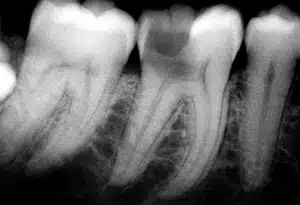
By the time a tooth hurts, though, the cavity is usually pretty close to the nerve. This means that if there is still enough tooth structure left to work with, the dentist may consider a root canal to remove the source of the pain – in other words – the nerve. Usually, this is not cheap. A root canal on a molar can cost over a thousand dollars when performed by a specialist. Then the patient has to go back to the dentist to have the tooth built up again (because so much tooth structure was lost to decay) and finally, the tooth may even need a crown. Lacking a blood supply and nerve thanks to the root canal, the tooth is now brittle and can break. Since your back teeth get a lot of pressure when you chew, failing to crown it may result in the tooth cracking and all that money you spent on the root canal goes out the window.
In a number of cases, because many people simply fear getting a root canal (not because they actually had one, but because they heard that a friend of a friend had a bad experience, and they never want to go through THAT), they opt to remove the tooth instead.
But now they have to replace the missing tooth or else their teeth will shift around and their bite goes awry. And fixing that new problem typically costs even more!
It can be frustrating.
Many people figure no one will see a missing back tooth, so why not pull it, since that is cheaper? At least they think so – until they notice their front teeth starting to form gaps, and find that food gets stuck all over the place whenever they eat. But then again, what if it’s a front tooth that needs to go?
You possibly think: “Wow, this is a problem, but I still really need to find something cheap.” OK, then. If you live in Philadelphia, you may Google “affordable Philadelphia dentist” or “cheap dentist.” A number of listings for dental implants appear, maybe some for “affordable cosmetic dentistry.” Wow, this isn’t sounding at all affordable!!! Wait! A couple of dental schools come up too. “Hmmm. Do I really want someone in their first year of dental clinic restoring my front tooth? It will be less expensive. But, then again . . . .”
The affordable dentist is someone who will understand your situation and can help you to find a workable solution for your circumstances. Many offices offer low-cost or interest-free programs that help you get the work you need today and then spread payments out over time. In some cases, it may be helpful to set up a lay-away program, especially if you have specific needs for which you have been given an estimate of treatment costs. In this manner you won’t end up spending your money on other less-essential items. Many offices will assess a minor fee to manage this plan, but it is usually quite small.
In the meantime, it is essential to keep yourself out of trouble with good preventive dental practices. Learn what diet has to do with your teeth and which home care habits are best. Remember, when it comes to teeth and gums, “no pain” most definitely does not always mean “no problems”.
“If it ain’t broke, don’t fix it.” Isn’t that how the saying goes?
Well, when it comes to teeth, most people really can’t tell if it’s broken.
Consider these interesting dental tidbits:
Periodontal (gum) disease is the number one cause of tooth loss world-wide. That’s basically a condition in which you lose the bone that surrounds your teeth, so that even healthy teeth may fall out.
Most people who get cavities diagnosed by their dentist didn’t have any idea that they even had a cavity.
A substantial number of patients who clench or grind their teeth — resulting in worn-out, chipped, and cracked teeth — swear that they don’t.
Some patients who come into a dental office convinced that they have a cavity because of pain, actually don’t have a cavity at all.
What the heck?! Yeah, it can get a little confusing, and that’s probably why at one point or another many people find themselves confronting a dental emergency. Some emergencies are simply the result of accidents. After nearly twenty years of practice, I have seen quite a lot of these too. But in reality, the vast majority of dental emergencies are simply caused by neglect. So here are a few tips on how to stay out of trouble:
1. Never open anything with your teeth. Just don’t do it. I have restored countless teeth after people tried to open or hold objects with their teeth. It’s not worth it. Grab a scissor, pliers, bottle-opener or whatever you need to do the job. Your teeth were made to chew your food.
2. Use an athletic mouth guard if you play sports. Sports are fun and can be great exercise. They can also cause teeth to get punched out, kicked out or knocked out. Use a professionally made mouth guard if you play sports.
3. See your dentist regularly. Some things can even be tough for your dentist to detect. Unless you have x-ray vision and can see inside your own head, you will never know if you have decay between your teeth until it is so large that it starts to look ugly or pieces of the tooth actually fall apart. Also, you don’t want your first realization that you have periodontal disease to come from noticing that your teeth are loose. Your dentist should also be checking for oral cancer at your examination visits. If you have it, early diagnosis can be a matter of life or death.
4. Brush and floss your teeth daily. There is simply no substitute for prevention. Brushing your teeth after every meal and flossing at least once a day goes a long way in protecting you from oral diseases — not to mention bad breath.
5. Wear a custom night guard if you grind or clench your teeth. Bruxism — the term used for the grinding or clenching of teeth, has been observed by dentists to be increasing in frequency among their patient populations. No doubt, stress has a great deal to do with this, but if you have been diagnosed with bruxism don’t take it lightly — because your teeth won’t either. I have also noticed a significant rise in bruxism over the last 10 or so years and its effects can be devastating.
Oh, and that emergency dentist you were thinking of using. You know, you saw the billboard on the way to work. He’s the one that is willing to see you 24/7. So, in the worst case scenario, you will have someone to go to, right?
I wonder how many people he has actually treated at 3:00 AM? If it happens at all, I’m certain it doesn’t happen often. Sure, you can CALL him 24/7, but you’ll be seen at the first opportunity. And if he does agree to see you after hours or on a weekend, it will likely cost you a few extra hundred in addition to the cost of your treatment. By the way, be prepared to bring cash, because he may not accept checks or a credit card from a brand-new emergency patient.
The moral of the story is simple. Use common sense and just don’t let things get that far along. If it has been more than six months since you have seen your dentist (unless you have full dentures) you are over-due. Even patients with dentures should see their dentist at least once a year to check the fit of their dentures, be evaluated for adjustments or relines, to have the dentures cleaned, and to check for oral cancer.
How long has it been since your last dental visit?
In today’s challenging economic climate, people find themselves having to make every dollar they spend count. As a result, individuals considering cosmetic dental work face the additional problem of not having such procedures be covered by dental insurance. For some, that puts treatment a little farther out of reach.
While it may be a common perception that cosmetic dental procedures are completely elective, many prospective job seekers have come to realize that having an unattractive smile could make the difference between being hired and being passed over for employment.
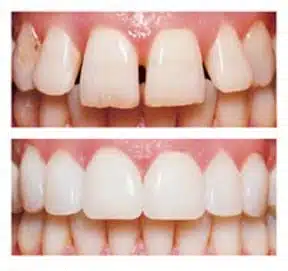
One of the most common methods used to improve flaws in a person’s smile has been the use of dental veneers. These are typically thin shells of porcelain that are bonded to the surfaces of a patient’s teeth and can be used to correct a variety of problems: from unsightly old fillings to crooked teeth or chips in the teeth. They can also close gaps, lengthen short teeth, or permanently brighten discolored teeth.
Porcelain has been traditionally chosen for the job because it looks natural, transmits light beautifully, and has excellent color stability. The life expectancy is also good, with many veneers lasting up to fifteen years. Unfortunately, at $1,000 to $2,500 per tooth, they can also be rather expensive.
Nevertheless, apart from the cost, their many advantages have made them a popular choice. There are several disadvantages, however. Among these is that most porcelain veneer procedures are irreversible. This means that the slight amount of tooth reduction necessary to create a natural appearance commits the patient to future veneers. Also, in most cases, multiple visits are required – with anesthesia. And should a veneer ever become damaged, or should it break, it is not easily repaired. It typically requires replacement.
Fortunately, an alternative form of treatment exists. As long as the dentist does not have to restore tooth decay as well, it can generally be performed without anesthesia.
This is known as a direct composite resin veneer. Instead of using porcelain to cover the tooth, a dentist places a very thin layer of composite resin – essentially, a tooth-colored filling material – over the tooth in order to create a similar effect. Whereas in the past, this solution sometimes resulted in a dull, lifeless appearance for a tooth, current composite resins available to dentists have improved significantly. Products on the market today have enhanced physical and optical properties that also allow the dentist to accomplish a dramatic change in a patient’s appearance in as little as one visit. Many composite resins can also be placed with little or no alteration of the tooth’s structure. Every person’s case is different, however. Your dentist should be able to give you an idea of what will be required to obtain the optimal esthetic result for your case. Expect to pay anywhere between $350 to $695 per tooth.
What if you break or chip a composite resin veneer? The repair is usually easy to accomplish in a single visit and at a significantly reduced cost to replacing a porcelain veneer. Are there any disadvantages? Frankly, these are among the most technique sensitive of all dental veneers. The skill of the dentist and their attention to detail are critical elements in achieving a good result.
Talk with your doctor about which options are right for you. It may still be possible for you to enjoy the benefit of veneers – at nearly half the cost. Most dental offices today offer flexible financing options, many of which are interest free. Your perfect smile may be much closer than you think!
Bad teeth may not only have negative consequences for your health, they can cost you a job.
Many people with visibly unattractive teeth go through life avoiding eye contact with strangers for fear of having to smile back or even to make small talk. Not infrequently, when such people do talk or feel compelled to smile, they cover their mouths with their hand.
Unfortunately, in a job interview, this will not go over well. Yet, for the person with dental problems, to smile or talk would compel them to reveal something they are deeply embarrassed about – their teeth. There is an old saying that you don’t get a second chance to make a first impression. And first impressions are typically based upon appearance. Your teeth, or even your breath, can either enhance or completely destroy your chances of landing that new position.
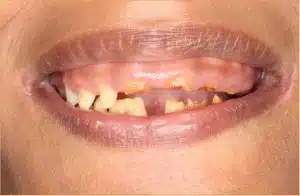
Teeth that are blackened by decay, are crooked, discolored, or even missing may not just be embarrassing – they may turn off prospective employers. Also, hiding your smile during an interview can be one of the worst things you do. A smile and a confident response project self-assurance and make a person appear likeable.
This is just one of many subtleties employers may take into account when interviewing a prospect. Teeth that are stained by coffee, tea or cigarettes may distract the interviewer from what is really important – you and your qualifications.
Likewise, coffee and cigarettes leave a smell that can be easily detected. Apart from not showing visible stains, a prospective job-seeker should also avoid certain other foods shortly before their interview. The most obvious offenders are garlic, onions, anchovies or tuna. But it is also prudent to steer clear of such lunch meats such as salami, pepperoni or pastrami before your interview. Strong cheeses, such as Roquefort, Camembert, or Bleu cheese also leave persisting odors and, similarly, should be avoided.
Women are cautioned to avoid getting lipstick on their teeth. Softer shades or lip gloss are preferable to bright red. Lipstick on your teeth can give you the appearance of being careless or hurried – which may also sink your prospects the moment you open your mouth to speak.
In today’s economy, competition for work is fierce. Applicants need every advantage they can get to land the job. Applicants’ teeth need to be as good looking as the way they dress, comb their hair, or even shine their shoes, because employers can afford to be selective with so many qualified people looking for work.
Recent research conducted in the U.S. estimates that those prospects with well-maintained teeth experience as much as a 58% higher chance of finding a job than those whose teeth are perceived as unattractive. It also seems that potential employees who have invested in dental treatment with cosmetic dentistry are regarded as more professional, congenial, and trustworthy.
Individuals seeking employment can increase their chances of getting work by taking several steps before their interview. These include getting a dental examination, completing unfinished restorative work and possibly even having cosmetic dentistry. The number of job seekers getting their teeth whitened and getting porcelain veneers placed (as a way to increase their chances of hiring success) is increasing for these very reasons. So what do you do if you can’t afford a Hollywood smile? Don’t worry, there are affordable answers.
If you need a lot of work and it is out of your reach, temporary cosmetic solutions such as a Snap-On Smile® can make a dramatic change in your appearance – very often at less than one quarter the cost of a more permanent solution. This is on the order of a functional, but temporary, smile design that snaps over your natural teeth. Once you land the job and start making an income, you can consider something more permanent!
ScienceDaily (2011-08-23) — Researchers in the UK have discovered a pain-free way of tackling dental decay that reverses the damage of acid attack and rebuilds teeth as new. The pioneering treatment promises to transform the approach to filling teeth forever.
Following is a reprinted article that outlines a real, but ultimately preventable, tragedy. As you will see from the attached video, some people scarcely believe that a tooth infection can produce such severe consequences.
September 9, 2011 — An unemployed man died last week because he couldn’t afford treatment for his infected third molar, according to news reports.
Citing physicians and family remembers, Cincinnati’s WLWT television station said the infection killed 24-year-old Kyle Willis when it spread from his tooth to his brain.
Dentists advised Willis, the nephew of funk bass player Bootsy Collins, to have the tooth extracted 2 weeks earlier, but Willis had no insurance and decided to wait, according to the report.
“He should have gone to the dentist to take care of the toothache, and it wouldn’t have escalated to this. It’s a lesson learned by all,” said Willis’ aunt, Patti Collins.
Suffering from headaches and swelling, Willis later visited an emergency department, where he got prescriptions for antibiotics and analgesics.
He could only afford 1 of the prescriptions and chose the pain medicine. Willis felt better, but swelling in his brain killed him.
Willis’ fate recalls the widely publicized 2007 death of 12-year-old Maryland boy Deamonte Driver, whose tooth infection also spread to his brain. Driver’s mother had trouble finding a dentist who would treat him for what she could pay. Physicians estimated that they had spent $250,000 trying to save him from an infection that could have been prevented by a simple extraction.
The Patient Protection and Affordable Care Act of 2010 expanded dental care subsidies for children of indigent families but has no provisions to pay for adult dental care. Many states have never offered adult dental benefits for Medicaid patients, and others have eliminated these benefits in recent years as revenues have shrunk in the recession.
Although Ohio does offer such benefits, Willis’ family had recently lost its benefits, according to ABC News.
In April, the Kaiser Family Foundation reported that 33% of people surveyed skipped dental care or dental checkups because they could not afford them.
Dentists who operate free clinics for the underserved say they are often overwhelmed by the demand.
Willis leaves behind a 6-year-old daughter. Family members are organizing funds for Willis’ funeral expenses and for his daughter’s college education. Donations may be made to: Kyle Willis Memorial Fund, 604 Ohio Pike, Cincinnati, Ohio 45245-2141.
Sounds like a pretty basic question for a dentist, doesn’t it? In fact, I’m not really asked that question often because “everybody knows” you should brush your teeth twice a day. But should you really?
After all, you can pick up almost any tube of toothpaste and it says right there” brush twice daily, or as directed by your dentist”.
Some time ago, I started asking patients how often they brushed their teeth when they came in for their periodic cleanings. The most common answer – by far – is “twice a day.” My next question is usually, “Yes, but when during the day do you brush?” As you read this, many of you who do brush twice daily are thinking “when I get up and again before I go to bed.”
If you have experienced dental cavities, that could be part of the problem.
When I mention this to patients I usually get this sort of silent stare. It’s kind of a cross between, “well that makes no sense at all” or, “then I might as well just give up.”
Let me explain.
It starts with an understanding of what causes dental cavities. There are a few basic elements. The most obvious is that you need to have a tooth. Additionally, you need cavity-causing bacteria. Then you also need a fermentable carbohydrate. This is an important point. Carbohydrates include sugars and starches, but the process of fermentation creates acids. Once the acids form, there is another element that comes into play: time.
If we break these factors down further, it is useful to look at what we can control in the cavity-causing process. For the sake of argument, let’s assume we are starting out with a full set of teeth, so that’s not entirely in our control. Next, there is the factor of cavity-causing bacteria. We all have both good and bad bacteria in our mouths. While I could get into a discussion of promoting the good and suppressing the bad, this is also not always easily controlled.
The next two factors, however, we have a great deal of control over.
We can control what we eat. Recognition of which foods are acid forming is also useful. But I’m a realist and understand that sometimes we are just going to eat (or drink) those things anyway.
And this is where the time factor comes in.
A little analogy may be helpful here. What would you do if you spilled a strong acid on your bare skin? Chances are you would run right over to the nearest sink and try to wash it off. But what if you had a leather jacket on and didn’t notice right away? First of all, you would end up with a hole in your jacket, but eventually – with time – it would reach your skin and start to hurt.
It’s much the same with teeth. Your enamel is a protective layer that doesn’t have any feeling because it is mostly mineral and doesn’t contain any nerves. But given enough time, the acid – even a weak one – breaks through and gets to the underlying softer and more sensitive areas. So, don’t give it time.
Change your brushing habits and do so after every meal. About a half hour after eating is ideal. If you absolutely can’t brush on occasion, chewing a sugarless gum (preferably containing xylitol) can help.
What most people do, though, is wake up and brush. Then they have breakfast and don’t brush. The acids that are formed following the meal slowly dissolve our tooth enamel. Roughly when the acids wear off, they have another meal or a snack and freshen up the acid. Few people brush after lunch, so it’s a few more hours of wearing the enamel away. Just when that acid wears off people freshen it up again with dinner. They don’t always brush after dinner either, so the acid now has even more time to work. Finally, they brush before going to bed. This cycle can, and typically does, go on for days, weeks, months and years. Given enough time, the cavity becomes large enough to require a filling.
So, if you only eat two meals a day, brushing twice a day is probably fine. But if you eat three times a day, how often should you brush? You get the idea.
The really odd thing is that I can go over this with someone thinking they get it. A couple of years later, I’ll ask: “How often do you brush your teeth?” Believe it or not, the answer is often the same as when I asked the first time. Hopefully, however, you will get it. Remember also that you can’t ignore flossing and expect to escape cavities, even if you do brush after every meal. The area between your teeth can’t be reached by the toothbrush bristles. About a third of all cavities filled by dentists occur in this location.
Nevertheless, if you follow the advice above I think you will find yourself encountering far less tooth decay over the years. Hoping it works for you as well as it has for me.
Dr. Richard Walicki is a dentist practicing general and cosmetic dentistry. While we hope you find the information contained herein interesting and useful, this blog is for informational purposes and is not intended to diagnose any oral disease. Dental conditions should be evaluated by your dental health professional or a qualified specialist.
Search by Topic
Get Access To The AWESOME Health Course
In this 12 week program, you’re going to discover how to achieve AWESOME health and double your energy with natural, tested, and scientific strategies. Just click on the image below:


 The affordable dentist is someone who will understand your situation and can help you to find a workable solution for your circumstances. Many offices offer low-cost or interest-free programs that help you get the work you need today and then spread payments out over time. In some cases, it may be helpful to set up a lay-away program, especially if you have specific needs for which you have been given an estimate of treatment costs. In this manner you won’t end up spending your money on other less-essential items. Many offices will assess a minor fee to manage this plan, but it is usually quite small.